

What is Wayfinding Signage?
Wayfinding signage is a system of visual cues and navigational aids, including maps, signs and symbols, designed to guide people through a space. Its main goal is to provide a clear path for users, letting them know where they are, how to reach their destination and other important information about a facility. Wayfinding signage is commonly found in complex environments, including airports, hospitals, college campuses, retail centres and commercial buildings. Ideally, wayfinding signage reduces stress and confusion for visitors in an unfamiliar setting by helping them find their way quickly and easily through a space. Clear, concise wayfinding signage leads to a more positive overall user experience for everyone.
What are the Four Types of Wayfinding Signage?
The four main types of wayfinding signage are: directional, identification, informational, and regulatory signs. Each type of sign serves a unique and specific role, and together they form a cohesive system that guides people through a physical space. Let’s take a closer look at each type:
Directional Signs
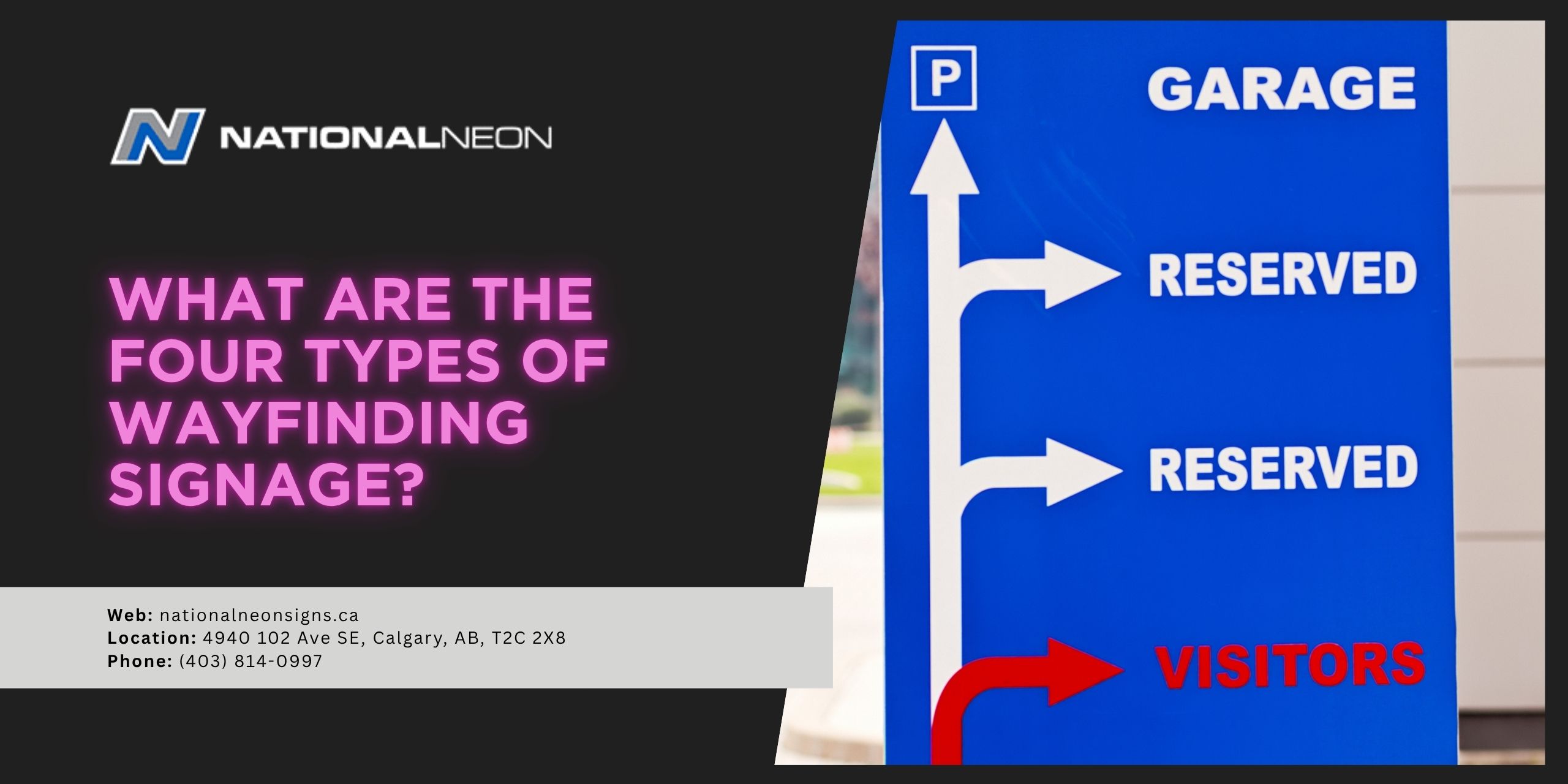
Directional signage guides people from one place to another within a space by showing a clear route to their final destination. This type of sign is essential at key “decision points”, like junctions or anywhere without a clear traffic flow. Directional signage might use arrows, overhead signs, monument signs, or floor vinyls to create a clear path from point A to point B. Effective directional signs are clear, consistent, and strategically placed to help people find their way easily and efficiently.
Some examples of directional signs include:
- An overhead sign in a hospital lobby, showing the directions to the emergency room
- Coloured arrows on the floor of a busy museum, guiding foot traffic
- Arrows in a shopping mall, guiding customers to the washrooms
Identification Signs
Identification signs are the most common type of wayfinding signage. They let you know where you are or confirm that you’ve reached your destination. Identification signs label rooms, landmarks, structures, or other points of interest. Instead of directing someone in a certain direction, identification signs say, “You are here”, helping users orient themselves within a space. Effective identification signs are short, simple, and to the point.
Some examples of identification signs include:
- Door plaques that specify the name or number of a room, such as “Conference Room” or “Manager”
- Floor numbers located near elevators to indicate which floor you are on
- Landmark signage, such as a historical marker
Informational Signs
Informational signs are used to provide useful information about a business or facility, and are not intended for specific route guidance. These signs give people broad, general information as they move through a space. Informational signs are usually placed in high-traffic areas such as lobbies, waiting rooms, or building entrances to communicate their message to as many people as possible. Informational signage should be universally understandable at a glance.
Some examples include:
- A general building map of a facility, located in the lobby
- A sign listing the hours of operation, located at a building’s entrance
- A list of available amenities, such as “Free Wi-Fi”
Regulatory Signs
Regulatory signs communicate rules, regulations, restrictions, and safety protocols within a space. Just like you must adhere to a speed limit sign when driving, every business and establishment has certain rules, ensuring the safety and security of all visitors. Regulatory signage helps convey this message, and in some cases, it is required by law and can help manage a business’s liability. Ideally, regulatory signs should be big and bold, with a clear, prominent message.
Some examples of regulatory signs include:
- “No Smoking”
- “Do Not Enter” or “Restricted Area”
- “No Alcohol Beyond This Point”
- “No Pets Allowed”
No one wants to feel lost or disoriented when visiting a new place, which is why wayfinding signage is so important. For more information, contact us today at National Neon, a reliable signage maker in Calgary.
