

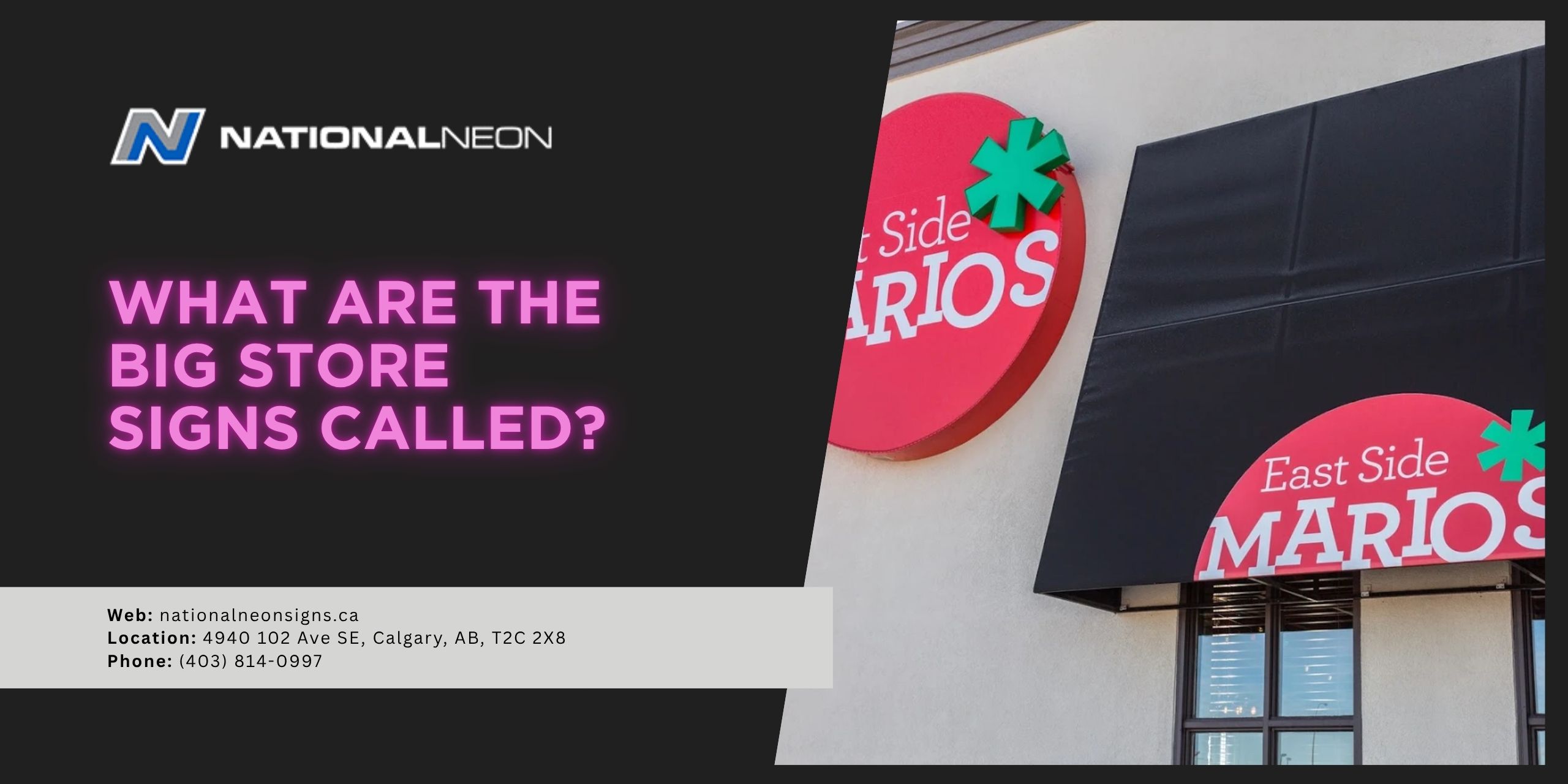
Walk through any commercial area, and one thing immediately stands out: big, bold signs on every storefront. These signs aren’t just for decoration. They’re designed to capture attention and leave a lasting impression on the viewer. But what are these big store signs actually called?
There are actually several types of storefront signs, and if you’re designing one for your business, you’ll want to know what kind you’re looking for. Let’s break down the most common types and see which one might be the best fit for your business.
What are the big store signs called?
A storefront sign is a general term that refers to any sign mounted on the front of a business, typically above the entrance. These signs display a company’s name or logo and are often the first thing customers notice when they pass by or approach the building. However, there are several types of storefront signs.
Let’s take a closer look:
1. Channel Letter Signs
Channel letters are three-dimensional, individually crafted letters mounted on a building’s exterior. Each letter is its own unit, with a metal body and an acrylic face. Channel letters are often illuminated with LED lighting, making them highly visible both day and night.
Channel letters are a popular choice amongst a wide variety of businesses, including:
- Restaurants and cafes
- Chain businesses
- Office buildings and professional services
- Shopping centres and malls
2. Cabinet Signs
Cabinet signs, or box signs, are large, enclosed sign structures with a durable frame and translucent face that allows light to shine through. They’re typically illuminated from within, which makes them easy to read both day and night. While they may not have the same modern, dimensional appeal as channel letter signs, cabinet signs are a more cost-effective option.
Because of their affordability and practicality, cabinet signs are often used by:
- Small businesses and local shops
- Restaurants and takeout locations
- Convenience stores or gas stations
- Service-based businesses like salons or repair shops
3. Blade Signs
Blade signs, or projecting signs, extend outward from a building, perpendicular to the wall. These double-sided signs are particularly useful in pedestrian-heavy areas, since they are visible from multiple angles rather than just straight on. Blade signs are often smaller than other storefront signs, but what they lack in size, they make up for in strong visibility in high foot-traffic areas.
Blade signs are commonly used by businesses in walkable shopping districts or busy downtowns, including:
- Boutiques or specialty retail shops
- Cafes, coffee shops, or small restaurants
- Salons or barber shops
- Bookstores or gift shops
4. Pylon Signs
Pylon signs, or pole signs, are the tall, freestanding structures you typically see near roads or highways. They are mounted on one or two poles and are designed to be visible from a distance. Some pylon signs near shopping centres might display multiple businesses located within the same complex.
Pylon signs are meant to catch the eye of fast-moving traffic, and are commonly used by:
- Gas stations and convenience stores
- Hotels and large commercial properties
- Retail plazas
- Fast-food restaurants and drive-thru locations
- Large retail stores located near busy roadways
5. Monument Signs
Monument signs are freestanding signs, similar to pylon signs, but are shorter and closer to the ground. They are typically built on a solid base, giving them a more permanent, refined appearance. Monument signs are often constructed from durable materials like brick, stone, concrete or metal, allowing them to blend with the surrounding architecture.
Monument signs are commonly used by:
- Office buildings
- Medical clinics or dental offices
- Schools, churches, or community centres
- Residential developments and apartment complexes
- Upscale retail centres
Are there other types of signs?
Yes, we’ve covered many of the most common storefront options, but there are other types of signage that businesses can use, depending on their needs, including:
- Digital Signs: Electronic displays that can rotate messages or update content in real time
- Window Graphics: Vinyl decals or perforated films applied directly to windows
- Awnings: Fabric or metal coverings that extend over a storefront
Do I need a permit for a large store sign?
Usually, yes, most cities and municipalities require permits for large store signs. Requirements typically cover size, placement, lighting and sometimes design. Always check your local area’s regulations before installing any storefront signage.
Ready to make your vision come to life? Contact us today at National Neon Signs!
